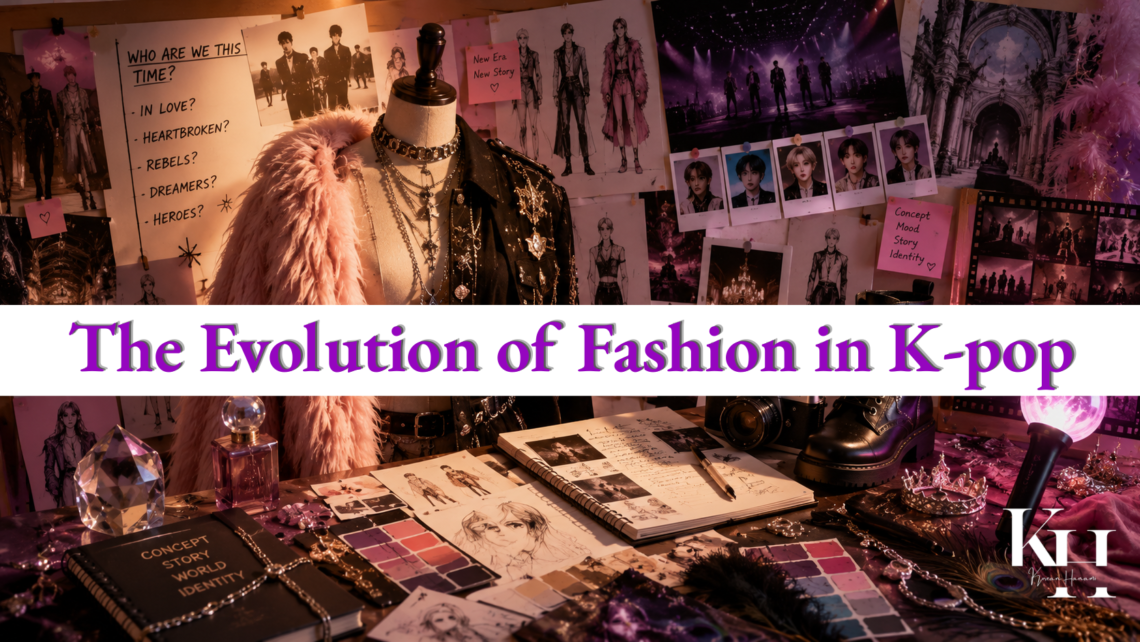
Clothes? It’s About Character | The Evolution of Fashion in K-pop
Once you dive deep into the answer, you’ll never look at K-pop fashion the same way again.
Most people assume idols wear luxury brands because they’re famous or because they’re ambassadors for Dior, Chanel, or Celine. That’s true, but it’s only one piece of a much bigger story.
In K-pop, clothes aren’t chosen to complement an idol. They’re chosen because every album begins with a character concept.
Before a stylist reaches for a denim jacket or a pair of boots, the creative director and styling team are asking a completely different question.
Who are we this time?
Are we in love?
Heartbroken?
Rebels?
Dreamers?
Heroes?
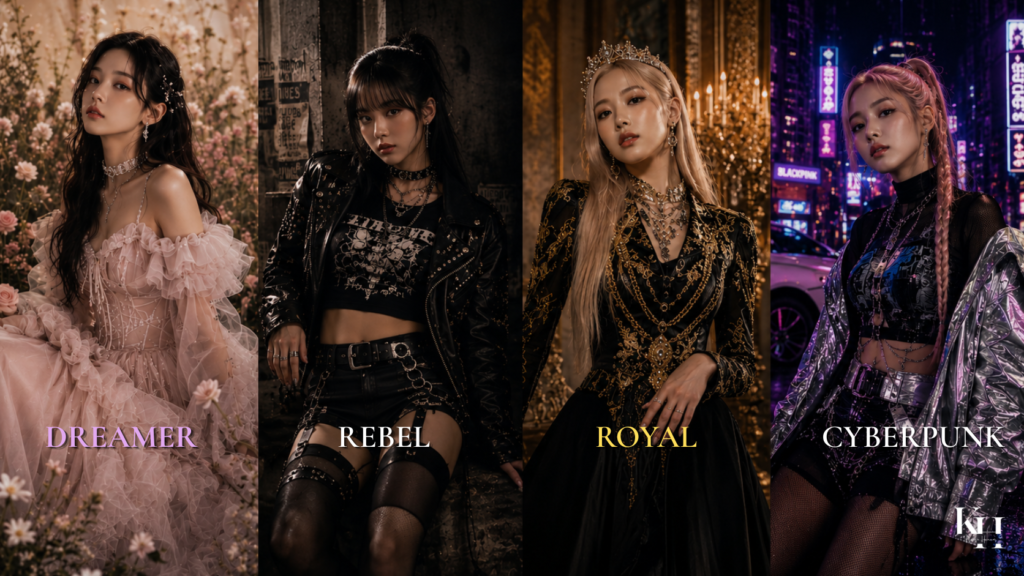
That single question shapes almost every creative decision that follows: the clothes, the hairstyles, the makeup, the album photos, the stage sets, and the accessories. Sometimes, even the smallest ring or necklace has a reason for being there.
Every single detail is carefully planned to introduce the story behind the concept.
And one of the smartest things K-pop understands is that we remember how a song made us feel long before we learn to sing every lyric by heart.
And that feeling often begins with a single image.
A pink fur jacket.
A black military coat.
A pair of angel wings.
A flash of silver hair.
These images become emotional bookmarks.
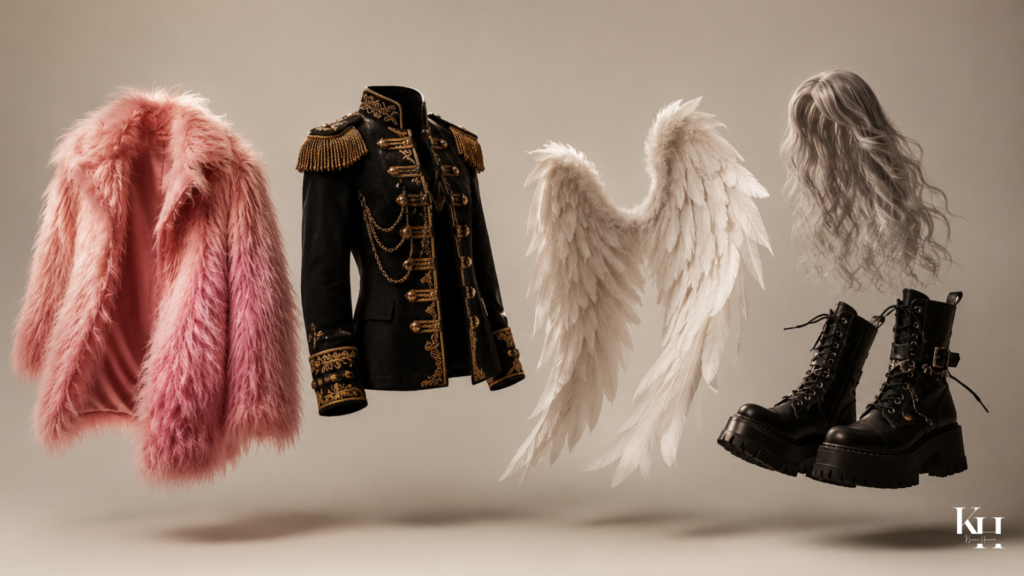
Years later, you don’t just remember the outfit; you remember exactly where that era took you and how it made you feel.
That’s why K-pop styling changes with every comeback. Every album is a new chapter, and every chapter deserves its own visual language.
If every album wore the same face, the stories would slowly begin to lose the distinct voice that sets them apart.
But did you know K-pop didn’t always speak this visual language? Like the industry itself, K-pop fashion evolved one era at a time.
The Evolution of K-pop Fashion: From Streetwear to Global Couture
K-pop fashion didn’t begin with luxury brands or front-row seats at Paris Fashion Week. It began with a generation that dared to dress differently.
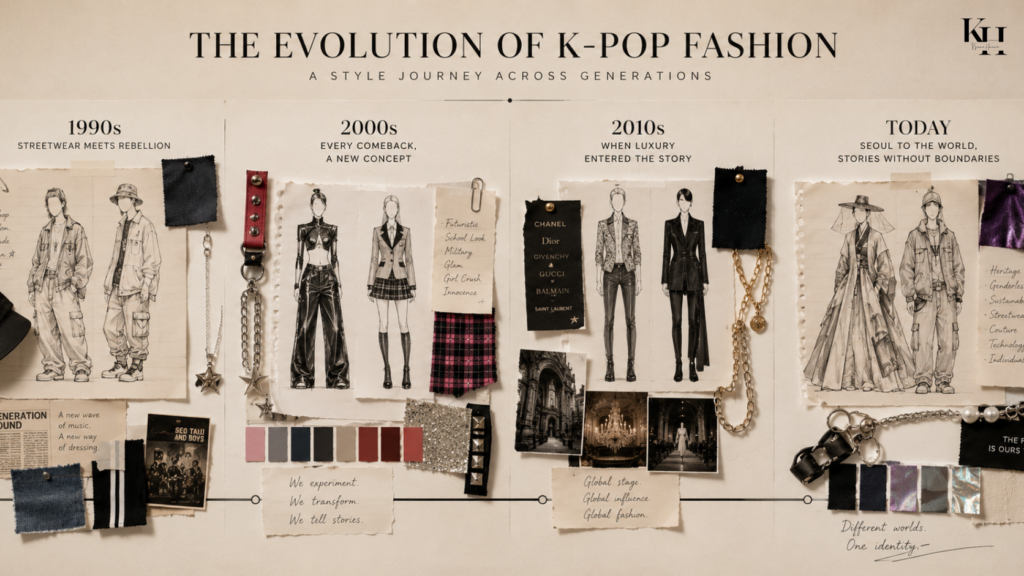
The 1990s: Streetwear Meets Rebellion
When Seo Taiji and Boys debuted in 1992, they didn’t just change the face of Korean music; they redefined the creative identity of Korean pop idols. Oversized silhouettes, baggy denim, sportswear, bucket hats, and American hip-hop arrived on Korean television in a way audiences had never seen before.
By the late 1990s, first-generation groups like H.O.T. and S.E.S. introduced coordinated stage outfits. While every member had their own personality, the styling created a shared visual identity, making the group feel united the moment they stepped on stage.
The 2000s: Every Comeback Became a Concept
As K-pop grew, styling became more ambitious.
Outfits were no longer chosen just because they looked fashionable. They were designed around a concept.
One comeback might lean into futuristic cyberpunk with metallic fabrics and sharp tailoring. The next could embrace preppy school uniforms, military-inspired looks, or glamorous sequins and glitter. Every album introduced a new visual language, giving fans something new to discover with every release.
The 2010s: When Luxury Entered the Story
As artists like PSY, BTS, and BLACKPINK introduced K-pop to a global audience, fashion evolved alongside it.
Luxury maisons such as Dior, Chanel, Celine, Louis Vuitton, Calvin Klein, and Miu Miu weren’t simply lending clothes to idols anymore. They recognized that idols had become powerful cultural storytellers with distinct identities. Brand partnerships became less about celebrity endorsement and more about finding ambassadors whose image naturally reflected each house’s creative vision.
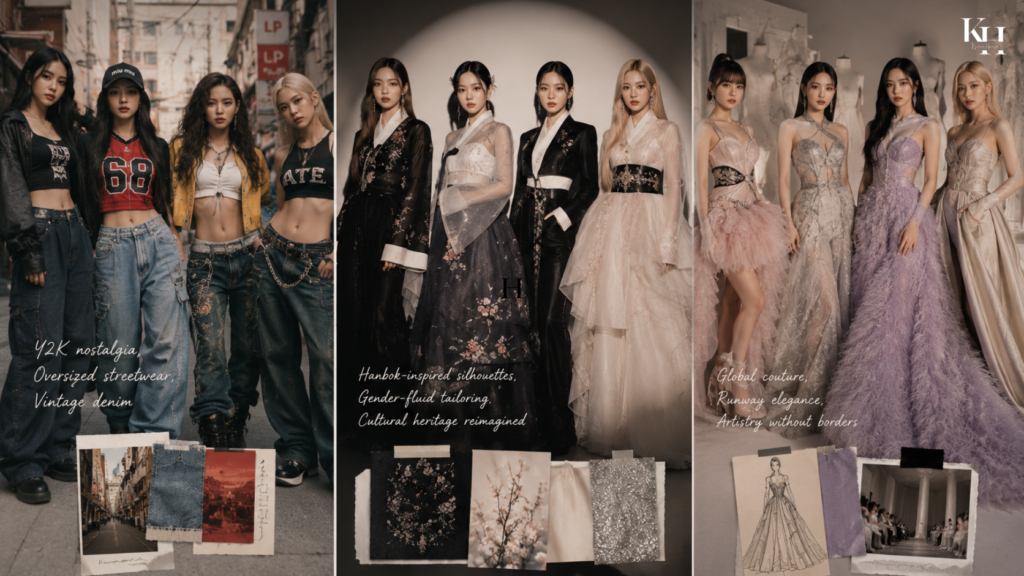
Today: K-pop styling moves effortlessly between worlds.
Seoul Street Style Meets Global Couture
One comeback might celebrate Y2K nostalgia, oversized streetwear, and vintage denim. The next could feature hanbok-inspired silhouettes, gender-fluid tailoring, or couture gowns straight from the runway.
Today, K-pop isn’t just following fashion trends; it’s helping to shape them. Its artistic direction moves effortlessly between Seoul streetwear, global couture, and Korean cultural heritage, creating an aesthetic that’s instantly recognizable around the world while remaining deeply rooted in their culture.
Why Every K-pop Era Looks Different
Think of BTS’s “DNA,” “Blood Sweat & Tears,” or “Butter.”
Or BLACKPINK’s “Pink Venom.”
Or IVE’s “Love Dive.”
You probably pictured the outfits before you remembered the choreography.
That’s by design.
Every comeback introduces a completely new world.
A different colour palette.
Fresh hairstyles.
Distinct makeup.
Concept photos.
Sometimes even airport fashion reflects the mood of the era.
Each element becomes a visual cue that helps fans instantly recognize a specific chapter in the group’s journey. That’s why one jacket, one hairstyle, or even one accessory is often enough to tell an entire era apart.
The styling signals to your brain: “We’re entering a different chapter, a whole new world.”
World-Building You Can Wear
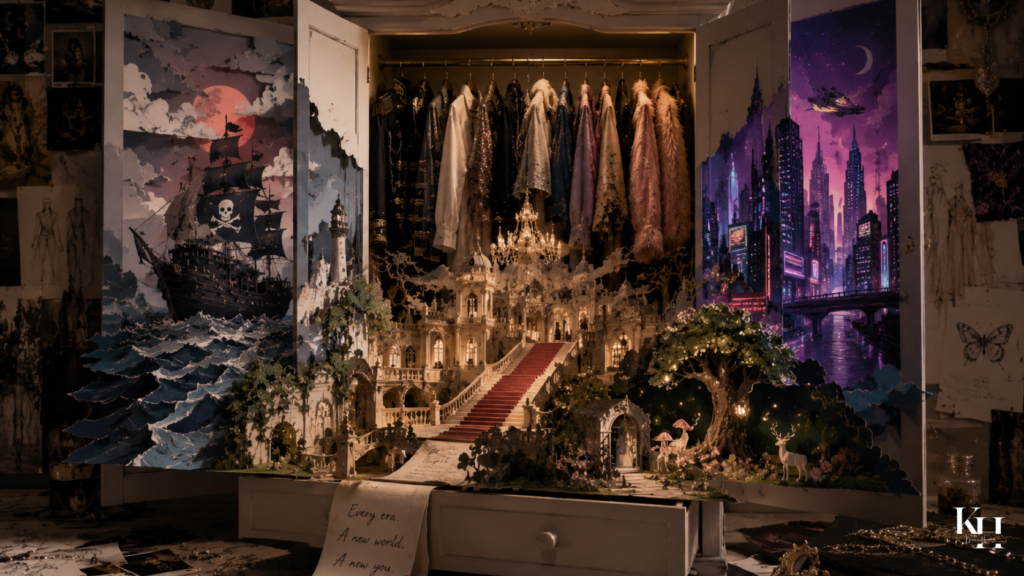
One of the reasons K-pop feels so immersive is because every album is built like a world rather than simply a collection of songs.
Some groups tell stories that unfold over multiple albums. Others create entirely new universes for every era. In K-pop, this is often called lore, a fictional world where music, visuals, symbols, and characters all connect to tell a bigger story.
That’s why Aespa’s futuristic styling feels different from ATEEZ’s adventurous, pirate-inspired aesthetic. They’re not just wearing different clothes; they’re dressing for completely different worlds.
Every choice has a purpose.
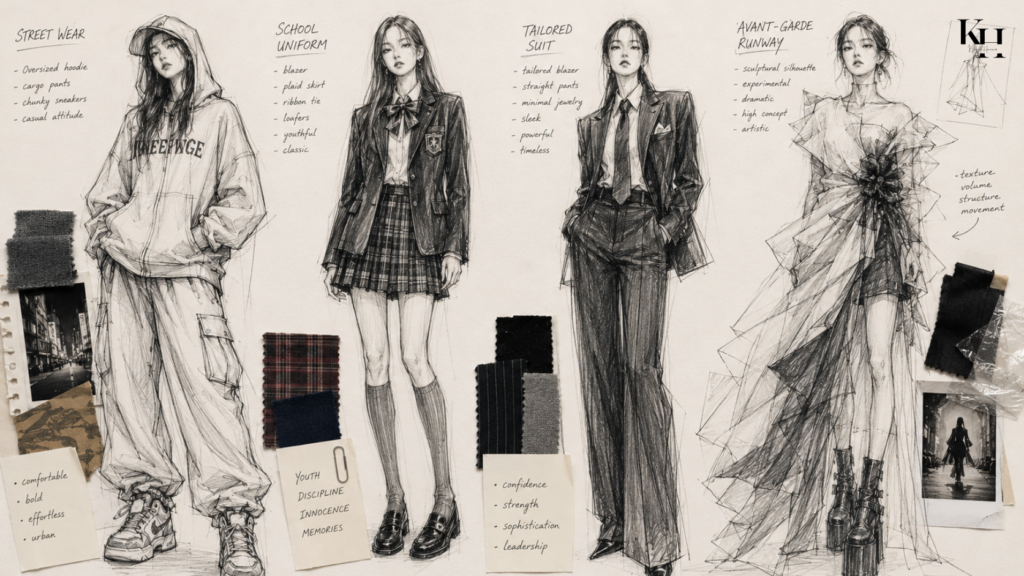
A leather jacket can signal rebellion.
White can symbolize rebirth or a new beginning.
Silver accessories often hint at technology or the future.
A school uniform can evoke youth, nostalgia, or belonging.
Even a change in hair colour can mark a new chapter in the story.
None of these details exist in isolation. Together, they create a world fans don’t just watch; they want to step into.
And that’s what makes K-pop fashion different.
You’re not just recreating your favourite idol’s style. You’re also becoming the character of the story.
Fashion Speaks Before You Do
Before someone says a single word, your brain has already started making assumptions.
That’s just how we’re wired.
Within seconds of seeing a person, we instinctively notice the colours, shapes, textures, and silhouettes they’ve chosen to represent themselves. Without realizing it, our brain begins asking questions.
“Can I trust this person?”
“Are they confident?”
“What’s their dominant energy: playful, quiet, rebellious?”
Clothes don’t answer those questions with certainty, but they quietly influence the first story we tell ourselves.
That’s why costume designers rarely choose outfits at random. A superhero doesn’t accidentally wear a cape. A detective isn’t usually dressed in bright neon. Before a character speaks, we’ve already formed an impression of who they are.
And K-pop understands this psychology exceptionally well.
An oversized hoodie can make an idol feel approachable and comforting, like a friend you’d want to sit beside after a long day. Put that very same person in a sharply tailored suit with structured shoulders, and suddenly they feel confident, mature, and in control.
The same shift happens with colour. Soft pastel palettes often create a sense of warmth and innocence, while darker tones can make a concept feel mysterious, bold, or intense.
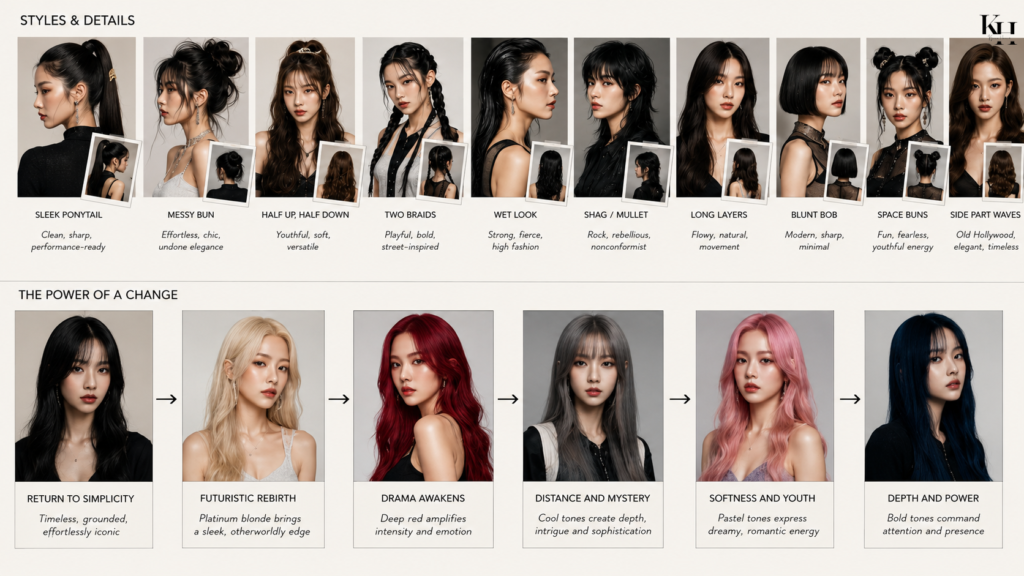
And it’s never limited to clothing. Sometimes, something as simple as a change in hair colour can completely reshape an era. Platinum blonde can make a concept feel futuristic. Deep red heightens drama. Natural black can make a return to simplicity feel intentional.
None of these choices tell us exactly what to feel. Instead, they quietly guide our imagination into the world the artists have created.
More Than Fashion, It’s Identity
If the K-pop industry has taught us one thing, it’s this:
People don’t just admire idols. They see possibilities for themselves through them.
That’s why every visual element matters. Fashion, choreography, music videos, album design, stage lighting, photography, and performance all work together to tell one complete story. Every detail strengthens the identity of an era.
It’s also why luxury houses choose idols so carefully. They’re not simply looking for celebrities with influence. They’re looking for artists whose identity naturally extends the brand’s story.
Most fans don’t buy the exact jacket their favourite idol wore.
Instead, they try a colour they would’ve never considered.
They experiment with a silhouette that once felt intimidating.
They find the confidence to express a side of themselves they hadn’t discovered before.
Because we were never really falling in love with the clothes.
We were falling in love with the version of ourselves K-pop helped us to recognize.
Previous Read: Why Are Stories Important?


You May Also Like
The Birth Flower of Each BTS Member | Korean Flower Symbolism

Stray Kids latest album ‘SKZ replay’ ranked 1 iTunes